
Welivedit.ai is content moderation, built for your wellbeing.
Online toxicity feels random, isolating and personal. It’s not.
It’s patterned, experienced by others like you, and systemic.
We’re looking for testers and pilot organisations
If you want to explore approaches to managing online toxicity that centre
- Reducing your exposure to harm during known trigger periods
- Facilitating peer support
- Building tech that recognises nuanced lived experience
Get in touch at contact@welivedit.ai

I saw a meme the other day – people using the internet to escape reality in 2006 vs people using reality to escape the internet in 2026. And I don’t think there’s a single person who wouldn’t say they’ve felt that at some point.
But actually, some of us could’ve predicted how a completely unregulated internet would go. Those of us with lived experience of harm offline could’ve warned of the risks of harm online.
Welivedit.ai gives people agency to control their exposure to harm – by tailoring models to their lived experience and learning the patterns of what they face.
The experience of online harm can make you feel both isolated and powerless.
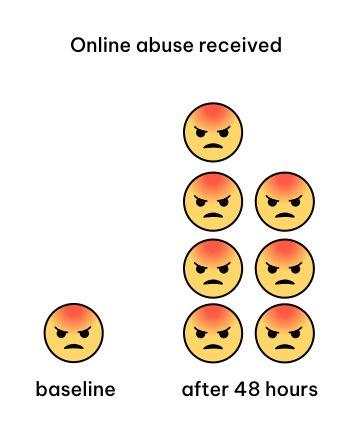
But in reality, it’s patterned – we tracked a public figure’s mentions before and after she spoke about the British Empire, and abuse went from 11% to 78% within 48 hours.
And these patterns extend across people – this public figure wasn’t the first person to have faced this. Other prominent women have received a noose diagram for the same reason. Different women, different platforms, same trigger, same script.
Which means it’s not always random; it doesn’t have to be faced alone – and if you connect with other people facing the same problem, there’s a collective power you can tap into.
Founder,
Madhuri Rahman

We’ve got more agency than we think we do...
We know: you can control your exposure to harm
Digital wellbeing means having a healthy and balanced relationship with technology.
For a long time, the only options on offer have been extremes: see everything, and absorb whatever that costs you — or leave, and lose the platform, the audience, the income, or the connection that mattered to you in the first place.
Neither is really a choice.
One asks you to endure. The other asks you to disappear.
But the landscape is changing.
There are already digital wellbeing tools out there to balance out how you use technology. You can track daily screen time, unlocks, and notifications, set app timers, schedule bedtime modes, and turn on focus modes.
If you’re controlling your doomscrolling, you can control how much toxic content you’re exposed to.
We know: what patterns of toxicity look like
Topics
Certain subjects reliably trigger abuse regardless of who raises them or how carefully — e.g. talking about the British Empire or immigration can trigger racist abuse. Similar patterns show up around trans rights, the NHS and policing.
Events
Large-scale, high-attention moments — the World Cup, general elections, by-elections, royal events, or other nationally significant news — create conditions where toxic comments spike sharply and briefly, then subside once the event passes.
Media
How a story is framed and reported shapes not just whether abuse happens, but how much and how fast. Sensationalist headlines, "controversy"-style framing, or coverage that presents a person as having done something scandalous — rather than neutrally reporting facts — can function as an ignition point, converting a niche story into a mass pile-on within hours.
Leaders
When someone with a public platform — a politician, commentator, or public figure — makes a statement about a specific demographic, it can trigger abuse directed at that entire community. E.g. a politician's comments about immigration can lead to a spike in abuse toward POC generally
Once you know these are triggers, not accidents, you can see them coming.
We know: people show up during toxic times

Our models are tailored to specific communities, so that we can show up for each other during periods of online toxicity.

Counterspeech
Responses to harmful speech that seek to challenge, expose, or undermine it

Positive Engagement
Re-dressing balance by posting supportive or encouraging messages

Public awareness
Sharing content written by people about their experiences of online toxicity, to raise awareness.

Reviewing or Reporting Data
Asking trusted individuals to review what the model flags, highlight anything that needs reporting
There are options for how we can respond as a collective.
We know: models that recognise context work

Content warning: Racism
We can rely on tech built for our lived experience.
We know: the regulatory landscape is shifting
Online Safety Act UK

The Online Safety Act has launched in the UK with specific guidance titled A Safer Life Online for Women and Girls. We will contribute to documenting evidence on the platform’s effectiveness in keeping its users safe through our community-labelled counterdata.
Counterdata

Centre for Countering Digital Hate (CCDH) conducted a study titled “Hidden Hate” (April, 2022) that showed that Instagram failed to act on 90% of misogynistic abuse and violent threats sent via direct messages to high-profile women, leaving reported rule-breaking accounts active. This means platforms don’t register this data as harmful.
The term “counter-data” was introduced in 2014 by geographers Craig Dalton and Jim Thatcher to describe acts of resistance that use data to upset dominant power relations.
Counterdata can help produce reports, artworks, infographics, social media campaigns, family support systems and protests in public space.
Community-driven AI

We have started by leveraging OpenAI LLMs to create our context-aware models. This is so that we can learn how to ‘talk to’ and teach the models to work for specific contexts.
As we begin piloting, we’ll transition to open-source BERT-based models. Communities can relabel data that the model misclassifies, easily review classifications as correct/incorrect, submit data for model fine-tuning, and see what the model is trained on.
We’re already living in an exciting period of change.